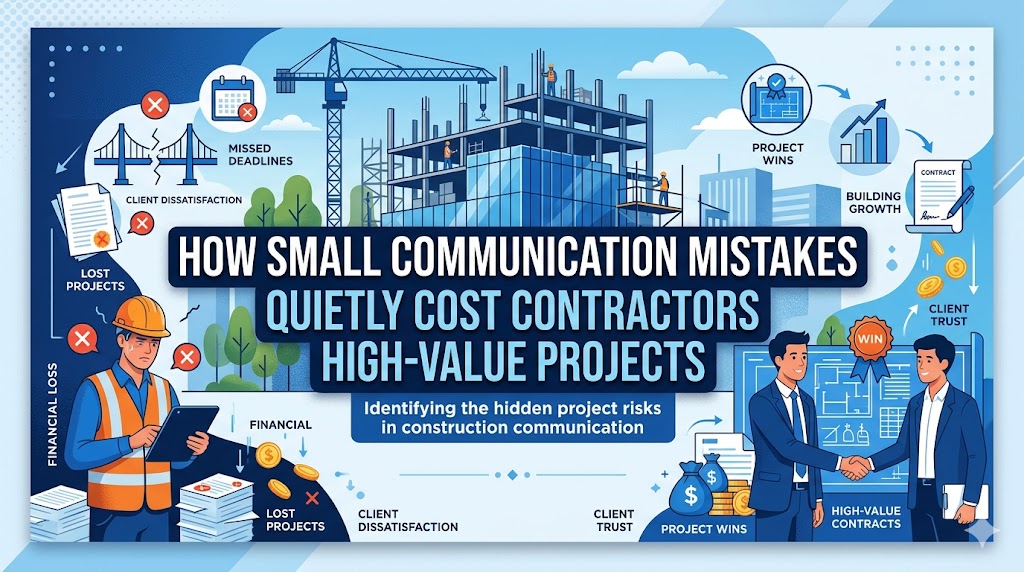
How Small Communication Mistakes Quietly Cost Contractors High-Value Projects
Why Clients Judge Reliability Through Consistency, Not Intentions
The $540,000 Project That Was Lost Over Small Details
Last Thursday evening, a general contractor in Miami sent a message after losing a $540,000 project. The client’s explanation was short but revealing: they felt the contractor “seemed disorganized.”
The contractor was not inexperienced, overpriced, or incapable of delivering quality work. In fact, the issue had little to do with craftsmanship at all. After reviewing the situation more closely, the breakdown came from a series of small communication mistakes that, individually, did not appear serious. He missed one follow-up call, forgot to send a material sample, and took three days to answer a simple question about project timelines.
None of these moments felt catastrophic on their own. However, together they created uncertainty, and in high-value projects, uncertainty is often enough to lose the deal.
Why Clients Use Small Interactions to Judge Bigger Outcomes
This reflects a larger reality within the construction and service industries. Clients rarely evaluate businesses based on isolated mistakes. Instead, they use repeated interactions to form a broader perception of reliability, professionalism, and organization.
One missed detail can easily become a signal of how the entire working relationship might feel moving forward. A delayed response may cause a client to question whether project timelines will also be delayed. A forgotten follow-up can create doubt about how organized the construction process will actually be once work begins.
Clients naturally use early experiences to predict future performance.
The Hidden Cost of Perception in High-Ticket Projects
For many contractors, this is difficult to recognize because clients rarely explain the real reason they move on. Most prospects do not openly say that delayed responses or inconsistent communication made them uncomfortable. They simply hire someone else.
As a result, business owners often assume they lost projects because of pricing, competition, or market conditions, when the actual issue was the client’s perception of operational consistency.
In high-ticket projects, perception matters significantly more than many contractors realize. When homeowners, developers, or commercial clients are preparing to invest hundreds of thousands of dollars, they are not only evaluating the quality of the work. They are evaluating how dependable the overall experience feels.
Communication becomes part of the product itself.
Why Trust Is Built Through Consistency
Trust is rarely established through one dramatic moment. More often, it develops through the accumulation of consistent actions over time. Every interaction contributes to a larger impression that clients use to predict their future experience working with a company.
The opposite dynamic is also true. Fast responses create reassurance. Remembering small details demonstrates attentiveness. Proactive follow-ups communicate professionalism and preparedness.
These seemingly minor interactions gradually build confidence because they help clients feel that the contractor is organized and in control of the process.
Over time, consistency becomes a form of credibility.
Why Systems Matter More Than Good Intentions
Most communication mistakes do not happen because business owners lack effort or care. They happen because too much relies on memory and manual follow-up. As operations become busier, details begin slipping through the cracks.
This is why systems are increasingly important for growing contractors and service businesses. Customer relationship management platforms, automated reminders, organized follow-up systems, and communication tracking processes help ensure that important details are not forgotten during busy periods.
These systems are not simply administrative tools. They are trust-protection mechanisms.
When systems support communication, businesses become more consistent. When consistency improves, trust increases.
The Contractors Who Create Certainty Often Win
Many contractors focus heavily on improving craftsmanship, upgrading tools, or increasing marketing efforts. While those investments matter, communication consistency often becomes the deciding factor when multiple qualified competitors are competing for the same project.
In industries where pricing and quality may appear relatively similar, the contractor who creates the greatest sense of certainty frequently wins.
Clients want to feel confident that their project will be handled professionally from beginning to end. Every response time, follow-up, and interaction either strengthens or weakens that confidence.
Final Thoughts
Ultimately, trust is built through hundreds of small moments that quietly shape how reliable a business feels. Those moments may seem minor internally, but externally they influence how clients predict the future experience of working with you.
In high-value projects, that prediction often determines who gets hired.
There is a visual that captures why growth feels harder than it should for most businesses. Once you see it, the pattern becomes obvious.
https://profitsx.com/online-reputation-audit

